
In the short run, the Trump presidency has already ensured one thing: The assumptions of the past can no longer guide the strategies of the future, points out Manish Dabhade.
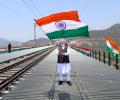
There are challenges galore before him, and it is not going to be easy. In the next four years, he has to conjure a system that changes the optics about him and the BJP both nationally and internationally so that he can ride back on his own, claim the top slot, and not have to lean on a coalition, asserts Ramesh Menon as Modi 3.0 completes a year in power.

'We should watch -- in the near term -- for signs that the two have totally fallen out at a personal, political level.' 'Trump and Modi know how to be dealmakers, but they also know how to hold a grudge.'

Chaudhary Charan Singh, who on Friday was conferred with India's highest civilian award Bharat Ratna, is popularly known as a champion of farmers.

Acharya emphasised that the time is "really ripe" for land, labour and agricultural reforms in India.

'If you align your ambition with India's rise, the peak of your careers will unfold alongside the peak of India's power.'

Can a culture survive as a way of life, even as the language and writing at its core, alter with time? Can we be rational and Malayalee or do we have to necessarily be religious and proudly cultural to be Malayalee? asks Shyam G Menon.
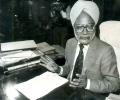
'Suddenly we had a new comprehension of affairs, which reminded that the luxury of politics floated atop a foundation by economics.' 'Along with this, finance ministers became crucial in molding the perception and reputation of Union Cabinets.' 'Governments couldn't afford a wrong person in that portfolio,' asserts Shyam G Menon.

The AAP chief stressed the need for an increase in healthcare spending, suggesting a rise to 10 percent of the GDP, along with the removal of taxes on health insurance premiums.

"Indian slums are incredibly productive," said Saumitra Jha, assistant professor of Political Economy at the Stanford Graduate School of Business.
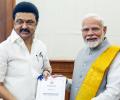
With its age-old fascination for education, southern states have done better than the North. Start-ups, IT hubs, and industry majors setting up shop have changed the face of the South. Nearly 79% of global offices set up by international conglomerates in India are in the South. Almost 46% of tech unicorns are from the South. The GDP per person in the South is 4.2 times higher than the North. None of these indicators can be ignored by any central government, whatever the political compulsions, notes Ramesh Menon.

Some important simple truths about the issue may be more helpful than high sounding debates, asserts Mohammad Sajjad.
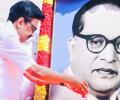
Given the possibilities that next year's assembly elections could throw up, Stalin told the state assembly that an interim report had to be submitted by January 2026. The outcomes may well find its way into the DMK's poll manifesto, thus seeking to keep the electoral focus still on the BJP-ruled Centre and Prime Minister Modi, observes N Sathiya Moorthy.
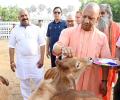
Uttar Pradesh Chief Minister Yogi Adityanath, known for his hardline Hindutva views and 'bulldozer justice' approach, has spoken out about his policies toward Muslims, the Waqf board, and his vision for India. He asserts that Muslims will receive a fair share of development in Uttar Pradesh, but not special concessions. He also criticizes the Waqf board for its alleged appropriation of government properties and calls for its reform. Adityanath defends his 'bulldozer justice' policy, claiming it is necessary for infrastructure development and removal of encroachments. He also discusses his vision for India, emphasizing the importance of Hindi as a national language and the need for unity across different linguistic groups.
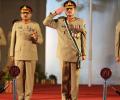
The launch of the first-ever direct train service from Delhi to Kashmir would be a big turning point in the Valley's mood and its integration with India. He had to thwart it at any cost, asserts Shekhar Gupta.
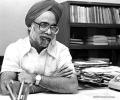
What stood out in his 15-year journey as a member of the political executive at the Centre was his glowing record as India's most successful and effective finance minister. Both as prime minister and finance minister, he understood the importance of gradualism, except when the economy or the polity was in a crisis.
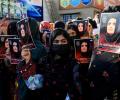
'When so many young Baloch men and women are willingly volunteering as fighters and even suicide bombers.'

'The time has come to have a relook at the Constitution as every document has a shelf life.'

A freebie once granted can hardly be discontinued. All that can happen is to substitute it with a bigger freebie, notes A K Bhattacharya.

'The first and most basic responsibility of any government is to protect its people from external threats and internal harm.' 'Budget 2025-2026 has to focus on meeting this responsibility,' asserts R Jagannathan.
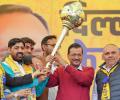
The BJP may win more seats in the February 5 assembly election, but not enough to trump AAP, notes Ramesh Menon.
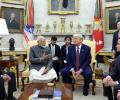
'By his words, actions, and body language during their joint press appearance wanted to convey his personal respect and, more broadly, his desire to work closely with India.'

'What's sad today is that there are so many people who cannot find work, not because the country is devoid of that opportunity, but because we are not doing enough in the country.'

A combination of demonetisation, a poorly and hurriedly implemented GST, and more recently the "botched up" lockdown of the economy to control the spread of Covid has brought the economy to its knees.

'While I would never wish for anyone to go through what we are, it has brought out the best in us by making each one of us a better version of ourselves.' 'Being courageous, fighting for freedom, taking the burden of responsibility to help each other...' 'I know hundreds and hundreds of examples where Ukrainians are risking their lives for complete strangers and it is only in moments like this that we truly understand what it means to be human.'
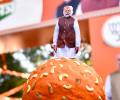
Delhi faces a severe financial crunch and the deficit is largely due to numerous welfare schemes without adequate revenue flowing in. The success of welfare schemes and electoral promises will need careful financial planning and out of the box thinking to whip up additional revenue, notes Ramesh Menon.

Calling RBI Governor Raghuram Rajan's exit a 'bad omen' for the Indian economy, eminent economists and former policymakers on Sunday said it will be seen by the world as India's non-approval to a policy against inflation and bad loans.
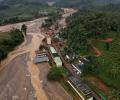
In the months immediately following the 2024 tragedy, reporting on the landslide per se had been a straightforward affair. On one side was death and destruction. On the other side, survivors and the business of survival. It was black and white. What direction to take was clear. Rehabilitation in comparison, felt like a complex situation. One that is fraught with shades of grey. As grey as human life, explains Shyam G Menon.

The disconnect with the AAP is that its economic agenda sounds suspiciously like Indira Gandhi's of the early 1970s: more subsidies, higher taxes, regulation of private school fees, free water, et al.

Development economist Jean Dreze said the Indian democracy is currently navigating a crisis that is not only limited to the 'recent wave of authoritarianism' but also suppression of opposition voices by the ruling Bharatiya Janata Party.

'The Indian government is better prepared this time and has reached out to all contenders and not putting all eggs in one basket.'

Dropping references to the demolition of Babri Masjid in Ayodhya, the killing of Muslims in Gujarat riots and Hindutva, and tweaking the reference to Manipur's merger with India are among the latest set of revisions made public by the National Council of Educational Research and Training (NCERT) in its textbooks.
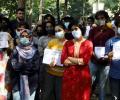
College is where the manicured view of the world provided by one's family, encounters new trends. It is the dawn of exploration. Wishing for a sanitised bubble on campus appears hypocritical. The correct strategy, one would assume, is to weed out the violence while retaining the right to political debate, argues Shyam G Menon.

If you love India, you cannot weaponise religion to stay in power, asserts Ramesh Menon, author, Modi Demystified: The Making Of A Prime Minister.

'The prime minister's comment on 'revdi culture' was welcome. But I am disappointed he did not follow up on that.' 'All political parties, including the BJP, have been guilty of this.' 'Now, Modi's guarantees, the Congress's 'nyay' path and both ruling and Opposition parties are vying with each other for freebies in my home state Andhra Pradesh.'

'it's not just youth in India who are left behind because of their inability to find jobs; nearly two-thirds of Indian women of working ages do not participate at all in the paid labour force.'

Khan, who faced his toughest political test since assuming office in 2018 due to defections in his party and cracks in the ruling coalition, in a surprise announcement during an address to the nation on Sunday said he had advised the president to 'dissolve assemblies'.

Six decades and more later, we are now captives of our identities. Every poll is based on elaborate calculations of electability of candidates on the basis of their castes and other narrow definers. That, along with voter promiscuity, is what defines our political culture, which remains stubbornly resistant to any change, asserts Shreekant Sambrani.
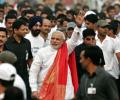
Most Indians expect their personal happiness will improve over the next five years, posing a concrete benchmark against which to measure the future success of Modi govt

When the landslide hit, Sruthi's house was washed away, along with its inhabitants. She lost her entire family and some relatives. All she had left for a close confidante was her fiance Jenson. Days after the landslide and the loss of her family, Jenson died in a road accident that also left Sruthi with serious injuries. News of the accident and Sruthi's backdrop as the lone surviving member of a family wiped out in the July landslide, was picked up by the media, and people rushed to help.
